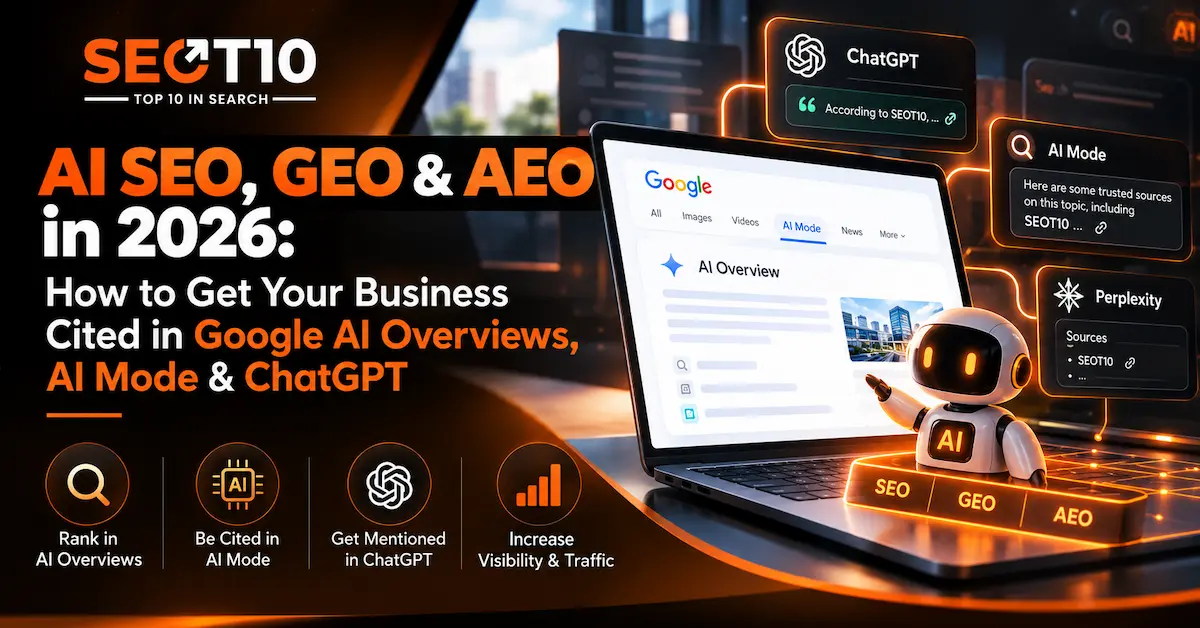
Quick answer: Generative Engine Optimization (GEO) is the practice of making your content easy for AI systems to find, trust and cite. In practice that means a clear 40 to 60 word answer near the top of each page, verifiable statistics and sources, consistent business details across the web, and clean technical SEO, so that Google AI Overviews, AI Mode and ChatGPT can use your pages.
Open Google Search Console and compare the last six months. If your impressions are climbing while clicks sit flat or slide, you have seen the shift first-hand. Your rankings may be perfectly fine. What changed is what happens on the results page.
SparkToro’s analysis of Similarweb clickstream data found that 68.01% of US Google searches ended without a click in the first four months of 2026, up from 60.45% in 2024. Two caveats: it is US data, and the two years used different data panels, so treat the exact gap with care. The same research found AI Overviews on more than 20% of searches, with click-through rates falling by nearly 60% when one appears.
Adoption explains why. On its Q2 2026 call, Alphabet said AI Mode has passed 1 billion monthly users, that it has merged AI Overviews and AI Mode into one search experience, and that the Gemini app has 950 million monthly users. ChatGPT reached 900 million weekly users in February 2026, and India is reportedly its largest market, with more than 100 million weekly users.
For a decade the goal was simple: rank in the top three blue links and win the click. That still matters. But a buyer who asks “which dental clinic in Sonipat is best for braces?” may now get a written answer with three names in it. If yours is not one of them, you never made the shortlist. To be fair, Google says its AI features also send billions of clicks to websites every week, so this is not the end of search traffic. It is a second game layered on top of the first.
At SEOT10 we built our affordable AI SEO services around this reality. This guide explains what AI SEO, GEO and AEO actually mean, how AI engines choose who to cite, a six-step framework, and how to measure it without expensive tools. I have tried throughout to separate what the data supports from what is industry folklore, because there is a lot of the second around.
What do SEO, AEO and GEO actually mean in 2026?
Agencies love acronyms. You do not need three separate teams. You need one search strategy that works across three layers.
| Layer | Where it shows up | Goal | How to measure it |
| SEO (Search Engine Optimization) | Google and Bing blue links, Google Map Pack | Rank commercial and local pages for high-intent queries | Clicks, rankings, calls, direction requests |
| AEO (Answer Engine Optimization) | Featured snippets, People Also Ask, voice assistants | Give short, extractable answers to how, what and how-much questions | Snippet ownership, voice answers |
| GEO (Generative Engine Optimization) | Google AI Overviews and AI Mode, ChatGPT Search, Perplexity, Gemini, Claude | Be the source and brand an AI answer cites or recommends | Citation share, brand mentions, AI referral traffic |
The point most people miss is that GEO sits on top of SEO. If Google cannot crawl, index and trust your pages, no AI system built on Google’s retrieval will find them. Google also says there is no special markup or file you need to appear in its AI features. The fundamentals of helpful, crawlable, well-structured content still apply.
How do AI search engines decide which brands to cite?
There are two broad mechanisms, and they reward slightly different things.
Retrieval: Google AI Overviews, AI Mode, Perplexity and ChatGPT Search
These systems search live. Google describes a technique it calls query fan-out: a long question is split into several sub-searches, relevant pages are retrieved, and an answer is assembled from the best passages. The pages that get used tend to be indexed, clearly structured, and direct about the sub-question they answer.
Model memory and entity consensus: ChatGPT, Gemini and Claude without live search
When a model answers from what it learned in training, it leans on associations: how often and how consistently your brand appears next to a service and a place across the web. Ask “recommend three affordable AI SEO providers for a Delhi clinic” and the names that come back are the ones the web has repeatedly connected to those words.
Ahrefs studied 75,000 brands and found that branded web mentions correlated with AI Overview visibility at 0.664, against 0.218 for backlinks. That is roughly three times stronger. Brands in the top quartile for mentions averaged 169 AI Overview mentions, against 14 for the quartile below. It is a correlation, not proof of cause, but it matches what I see in practice: brands that get talked about get cited. A mention in a respected publication, a directory listing and a genuine customer review all count.
What is the six-step GEO and AEO framework?
Whether you run a clinic, an online store or a manufacturing unit, these six upgrades are where I would start.
Step 1: Put a short answer at the top of every page
Directly under your H1, and under each question-style H2, write a direct answer of roughly 40 to 60 words that includes one concrete number or price range. This is a working heuristic, not a Google rule, but it fits how retrieval systems lift passages and it helps human readers too. If your page opens with 300 words of “in today’s fast-paced digital world”, a competitor who answers first will be quoted instead of you.
Step 2: Add what is actually citable
The research paper that coined the term, GEO: Generative Engine Optimization (Princeton, Georgia Tech, the Allen Institute for AI and IIT Delhi, presented at KDD 2024), tested nine tactics across 10,000 queries. Adding quotations, statistics and cited sources produced the biggest visibility gains, up to around 40% in their tests, while keyword stuffing did little or hurt. That was a controlled study, not a guarantee for your site.
In practice, replace “many customers prefer local search” with a number and its source. Cite primary sources such as Alphabet earnings calls, government portals or peer-reviewed studies. Attribute a quote to a named person, like your lead doctor, engineer or strategist, because anonymous testimonials carry less weight.
Step 3: Write headings as questions and include a table
People now give AI Mode long, multi-part questions such as “is AI SEO worth it for a small business in India, how long does it take and what does it cost?” Shape your H2s and H3s as natural questions and answer each in its own section. A comparison table covering price, features and timeline gives machines unambiguous rows to read.
Step 4: Use schema to be clear, not to game
Add Organization or LocalBusiness schema with your exact name, address, phone, coordinates and sameAs links to your real profiles. Add Service and Offer markup for packages, Article markup with author details, and FAQPage markup where you genuinely have FAQs.
Two honest points. Schema will not magically win citations, and Google has largely restricted FAQ rich results to a few site types. Its real job is removing ambiguity about who you are and what you sell, and the markup must always match what is visible on the page.
Step 5: Build the same story across the web
Since mentions seem to matter more than links, make sure your name, address, phone number and service category are identical everywhere. That means your Google Business Profile, Practo for doctors, Shiksha or Careers360 for colleges, IndiaMART or TradeIndia for manufacturers, and Clutch or GoodFirms for agencies. Keep your profile active with posts, Q&A and real reviews.
Then publish something worth referencing. Original local data, such as our Sonipat SEO pricing guide, gets cited because it cannot be found anywhere else.
Step 6: Do not block the crawlers that matter
I regularly find sites that block everything through an aggressive firewall rule or an old robots.txt file. Know which bot does what:
- Googlebot controls eligibility for Google Search, including AI Overviews and AI Mode.
- Google-Extended is a separate control over whether your content is used with Gemini models. Google says it does not affect Search inclusion or ranking.
- OAI-SearchBot supports ChatGPT search results, while GPTBot relates to model training.
- PerplexityBot covers Perplexity.
Whether to allow training crawlers is a business decision. Blocking search crawlers, though, means opting out of being recommended.
What does not work, and what do Google’s 2026 spam updates mean?
Mass-produced pages, doorway pages and scaled low-value content are exactly what spam systems target. Google released its September 2026 spam update on 24 September, its fourth of the year, and it finished rolling out on 8 October. Google does not penalise AI-assisted writing as such. Its spam policies target content produced at scale mainly to manipulate rankings, however it is made.
My rule is simple. AI can help with research and first drafts, but a person who knows the subject must add original data, real experience and an editor’s judgement.
How do you track AI SEO performance without expensive tools?
- A GA4 AI referral segment. Build an exploration that filters session source by a pattern like chatgpt\.com|perplexity\.ai|gemini\.google\.com|claude\.ai|copilot\.microsoft\.com. Volumes are small today, and some AI visits arrive with no referrer so they appear as direct traffic. Treat the number as a floor.
- Branded search lift in Search Console. Someone reads your name in an AI answer, then types it into Google. Rising branded impressions and clicks are the best early signal I know of.
- A monthly 20-prompt audit. List the 20 questions your buyers really ask. Run them in Google (AI Overviews or AI Mode), ChatGPT and Perplexity, ideally logged out, and record whether you are cited, named, or missing. Answers vary, so repeat each prompt a couple of times and look for the pattern rather than a single result.
Some reports suggest visitors from AI assistants convert better than average search visitors, plausibly because they arrive pre-qualified. I would treat that as a hypothesis to test in your own analytics, not a fact to plan around.
Frequently asked questions about AI SEO, GEO and AEO
1. Does Google penalise AI-assisted content?
Not for using AI tools. Google’s spam policies target unoriginal, mass-produced content made mainly to manipulate rankings. AI-assisted research combined with genuine expertise, original local data and strict editing is a different thing, and it can rank and be cited normally.
2. Are affordable AI SEO services suitable for small local businesses?
Often more so than for big brands. National portals rely on generic, templated city pages. A local clinic, school or B2B firm that publishes real prices, neighbourhood detail and genuine reviews offers something they cannot. Start with the fundamentals: a strong Google Business Profile, one solid page per service, schema, and reviews. Our Starter plan at ₹7,999 a month covers up to 15 keywords, 2 blog posts, 6 Google Business Profile posts and schema fixes for up to 15 pages.
3. How long does it take to get cited?
There is no honest guarantee. In our experience, pages already ranking on the first or second page can pick up AI citations within a few weeks of adding direct answers, statistics and clean markup. Visibility in chat assistants builds more slowly, usually over months, because it depends on mentions accumulating elsewhere.
4. Do I still need traditional SEO?
Yes. AI systems retrieve from pages that Google can already crawl and trust. Our search engine optimization services and the guide on choosing an SEO agency in Sonipat cover the foundations.
Get found where your buyers are now asking
Do not wait until competitors own every AI answer in your industry. Explore our AI SEO services, compare plans on the pricing page, or request a free AI and technical SEO audit from the SEOT10 team on +91 82228 56056 or info@seot10.com.